A 7-stage protocol for fish tissue collection in genome & transcriptome sequencing
High-quality sequencing starts long before the lab — it starts at the riverbank. For genome and especially transcriptome work, the single biggest determinant of data quality is how fast and how cold you handle tissue after capture. Endogenous ribonucleases degrade cellular RNA within minutes at ambient temperature, so the whole procedure is a race against time and a discipline of preparation.
Below is the full seven-stage protocol I use in the field for collecting fish tissues for sequencing. It’s written for freshwater fishes, but the principles transfer to most vertebrates.
Stage 1 — Capture & transport
- Target collection. Capture wild specimens using low-impact methods (seine netting, electrofishing, or angling) to minimize mechanical injury and physical stress.
- Aerated live transport. Transport live specimens in clean containers filled with native river or lake water, kept continuously oxygenated with a battery-powered air pump or a diffuse oxygen cylinder. Minimizing pre-mortem physiological stress prevents shock-induced transcriptomic changes and tissue hypoxia.
Stage 2 — Equipment preparation
- Sanitization & sterilization. Wipe down surfaces and sanitize dissection tools (surgical scissors, fine forceps, scalpels) with 70% ethanol, followed by an RNase decontamination solution such as RNase AWAY.
- Consumables & cryo-gear. Pre-stage sterile screw-cap microcentrifuge tubes (1.5–2.0 mL cryovials), a wet-ice box, a liquid-nitrogen (LN₂) benchtop dewar, and molecular-grade 100% ethanol.
Stage 3 — Documentation & sampling
- Systematic labeling. Prepare water-resistant, solvent-proof cryo-labels
pre-printed with standardized metadata codes (e.g.
Pkau-M1for Pseudoscaphirhynchus kaufmanni, muscle, specimen 1). - Voucher photography. Lay the fresh specimen flat on a clean board with a metric ruler and its printed label. Photograph the lateral body profile, fins, and diagnostic taxonomic traits before any incision.
Stage 4 — Tissue extraction (time-critical: <10–15 min)
- Rapid multi-tissue dissection. Systematically excise target tissues in a fixed order — muscle, skin, heart, liver, brain, spleen — into their corresponding labeled cryovials.
- Mitigating RNA degradation. Complete the entire harvest within 10–15 minutes post-euthanasia. RNases degrade RNA rapidly at ambient temperature, so speed is essential for high-quality transcriptomic data. Clean or flame tools between tissue types to eliminate cross-contamination.
Stage 5 — Immediate freezing
- Flash freezing. Plunge filled, tightly sealed cryovials directly into the LN₂ dewar at −196 °C. Flash-freezing instantly arrests enzymatic activity, preserving high-molecular-weight (HMW) DNA and RNA.
Stage 6 — Ethanol preservation (voucher / backup)
- DNA & morphological backup. Place remaining body tissue, whole fin clips, or entire voucher specimens into 100% molecular-grade ethanol at a 10:1 ethanol-to-tissue volume ratio, stored at room temperature or 4 °C. This preserves DNA for genomic verification and archives morphology for taxonomy.
Stage 7 — Storage & transport
- Dry-ice cold chain. Transfer cryovials from liquid nitrogen into an insulated container of dry ice for intermediate transport to the primary laboratory.
- Ultra-low freezing. Move samples immediately into a −80 °C freezer for long-term storage, and maintain an unbroken cold chain on dry ice during final express shipment to the sequencing facility.
Here’s the whole protocol at a glance:
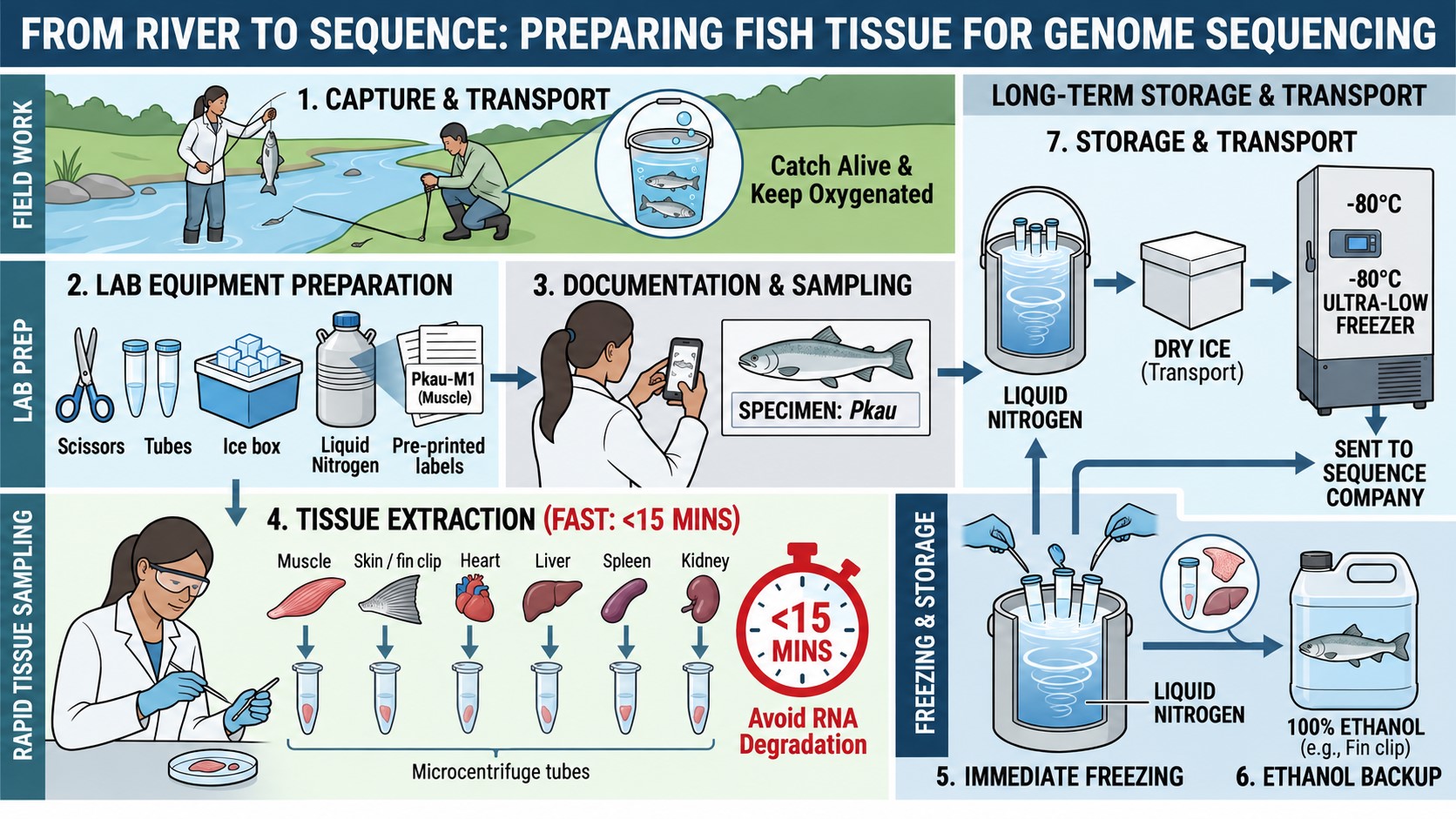
Why the cold chain is non-negotiable
Every stage above exists to protect the molecules you’re paying to sequence. Warm tissue means active enzymes: RNases shred RNA and DNA fragments over time. Flash-freezing in liquid nitrogen halts that chemistry almost instantly, and the −80 °C freezer keeps it halted. A single gap in the cold chain — a tube left out, a dewar run dry — can quietly ruin a sample you travelled hundreds of kilometres to collect.
The ethanol voucher is both insurance and reference: it preserves DNA robustly without a freezer and keeps a physical specimen tied to the genomic data, which matters enormously for taxonomy and for anyone who later needs to know exactly what was sequenced.
Get the preparation and the cold chain right, and everything downstream — extraction, library prep, assembly — starts from the best possible material.